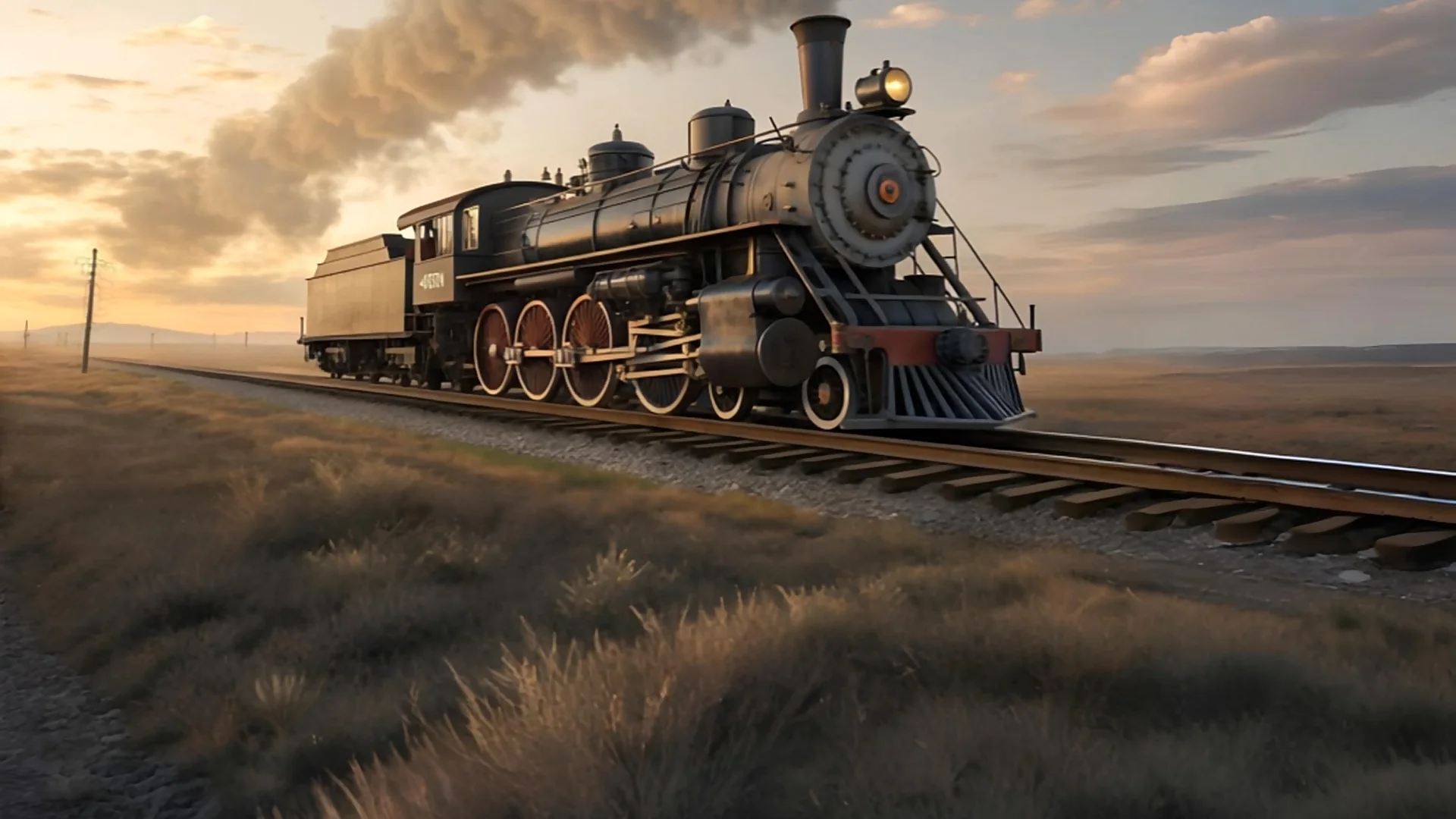

Museum of the History of the Belarusian Railway
44e151eeaa9110eef6fa0c327e012624
Opening of the Stockton-Darlington Line
The opening of the Stockton-Darlington Line took place on September 27, 1825. George Stephenson (see the appendix "Stephenson's Steam Engine") pulled a train weighing 90 tons, consisting of 34 carriages, six of which were loaded with coal, and the rest could accommodate over 400 passengers, at a speed of 19 to 24 km per hour. Members of the admissions committee were traveling in one of the passenger carriages, "Experiment". This was the first case in world practice of using a railway with steam traction for transporting passengers. As a result, the question of using steam on the railway as a motive force was resolved. And since 1825, it is customary to begin counting the world history of railway communications.
During the construction of the Stockton - Darlington road, J. Stephenson became convinced that the slightest climbs significantly reduced the speed of the locomotive, and on slopes, primitive brakes became ineffective. He came to the conclusion that in the future, large unevenness of the terrain should be avoided on new roads. When designing lines.
When designing the Bolton - Leigh and Liverpool - Manchester lines, J. Stephenson solved difficult technical problems: several complex cuts, bridges and viaducts were laid, designed to smooth the longitudinal profile of the track; iron rails on stone supports were used, which contributed to the increase in train speed.
Sources:
History of the Belarusian Railway. From the 19th century to the 20th century. - Mn.: Mast. lіt., 2012.
Stephenson's Steam Locomotives
George Stephenson (09.06.1781 - 12.08.1848). He was born in Willam near Newcastle, the center of coal mining in England. His father was once a simple coal miner, later he serviced a steam hoist in the mines. From childhood, his father took his son to the mine and told him about the purpose and structure of the machine. From the age of eight, the boy worked for hire. At 18, he learned to read and write. A strong desire to learn about steam engines helped him acquire the specialty of a steam engine mechanic. He had rare abilities and diligence. In 1802, he got a job as a machinist in a coal mine. Since 1808, with a reputation as an excellent machinist, George Stephenson received a position in the Kellingworth mines. In 1812, George Stephenson stopped servicing steam engines and began to design them independently.

Developed by Tehno-Sky LLC